
Our team members come from a wide variety of backgrounds, such as Artists, Mountain Instructors, Engineers and Scientists to name a few. All give up a large amount of their time to train and provide a voluntary search and rescue service day or night, year round.
If you are interested in becoming a team member the requirements are as below.
If you meet all of these requirements please get in touch for further details by emailing join@aberdyfi-sart.org.uk
For further detail of the Team’s Operation, see our annual report below.
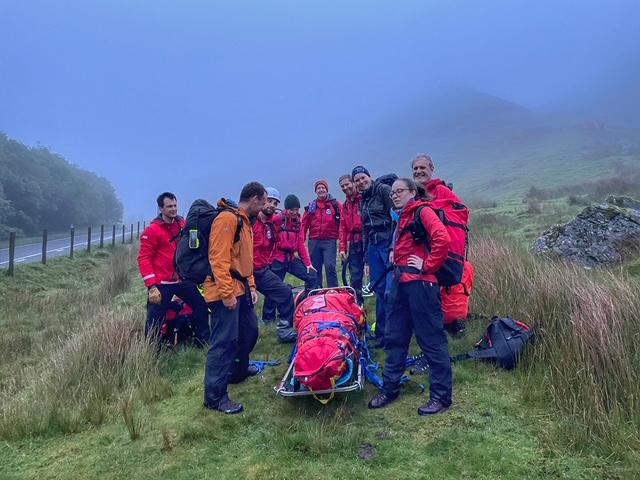
The Team provides Search & Rescue Services in the Dolgellau, Corris, Tywyn, Aberdyfi, Bala and Machynlleth areas together with Cadair Idris, Aran Fawddwy, The Berwyns and Southern Snowdonia. Also cover Plynlimon for Dyfed Powys Police.
Explore our journey

North Wales has attracted those who love the mountains since time immemorial. The first documented ascent of Yr Wyddfa (or Snowdon) was by the botanist Thomas Johnson in 1639 and by 1896 traffic on the mountain was sufficiently heavy to inspire the building of the mountain railway to the summit

In 1950, and formed from the amalgamation of the First-Aid Committee and various other organisations trying to improve rescues in mountainous terrain, the Mountain Rescue Committee (MRC, now Mountain Rescue England and Wales; MREW) came into being. Initially, there was little direct communication with teams beyond the six monthly meetings of the MRC in Manchester.

At the turn of the decade, mountain rescues within our area were being co-ordinated by the Fire Brigade at Dolgellau Station. However there was a growing concern in some circles about what was regarded as ineffective coordination from an organisation seen as having little or no expertise in mountaineering and mountain rescue.

The OB Rescue Team activity was popular with the instructors, but a shift in the structure of the Outward Bound course away from the original 28 days to much shorter offerings created staffing problems, and much less instructor “free time” than had been experienced towards the end of the longer courses where the students were essentially self-reliant.

With a membership now drawn from across the community and a cascade call-out system that would run for another 10 years, the Team remained superficially the same. However, beneath the surface there were subtle shifts that still echo on many years later. As membership shifted slowly away from O.B. staff, so too did any benefits related to work-place outdoor clothing allowances.

In 2000 the Team was awarded the Chief Constables Commendation for commitment and valour. At the turn of the millennium, the Team maintained (as it does still) a store of equipment at OB, and use was still being made of OB minibuses, but as a now increasingly independent organisation, other approaches were coming into play.

It was starting to become apparent that the ad-hoc approach to recruitment was perhaps not the most fair in terms of opportunity, and not a particularly supportive environment for the trainees themselves. The Team was also getting to a point where expressions of interest to join were starting to outstrip requirements.

The mentoring process for new recruits had variable success as it depended very much on how proactive individual mentors could be. In 2022, to standardise the experience, the mentoring process was abandoned in favour of placing the aspirant recruits under the care of a dedicated recruitment -team.